Cheap does not have to mean poor. One Saturday, the children and I spent the better part of the afternoon on fresh groundnut — buying it, sitting together to sort and prepare it, cooking it slowly from start to finish. It cost far less than the packaged snacks it replaced that week, and it turned into one of those small memories the children still bring up.
Why cheap does not have to mean poor
There’s a common idea that eating well and eating cheaply are opposites — that a balanced family diet requires either more money or more time than most households actually have. For many Nigerian families juggling work schedules, school runs, and tight budgets, that assumption adds guilt on top of an already difficult balancing act. The truth is more useful than the assumption: many of the most nutritionally solid foods available are also among the least expensive, if they’re approached with a bit of planning. Cheap does not have to mean poor in nutrition, and it does not have to mean poor in the experience around the food either.
What “affordable and balanced” actually looks like
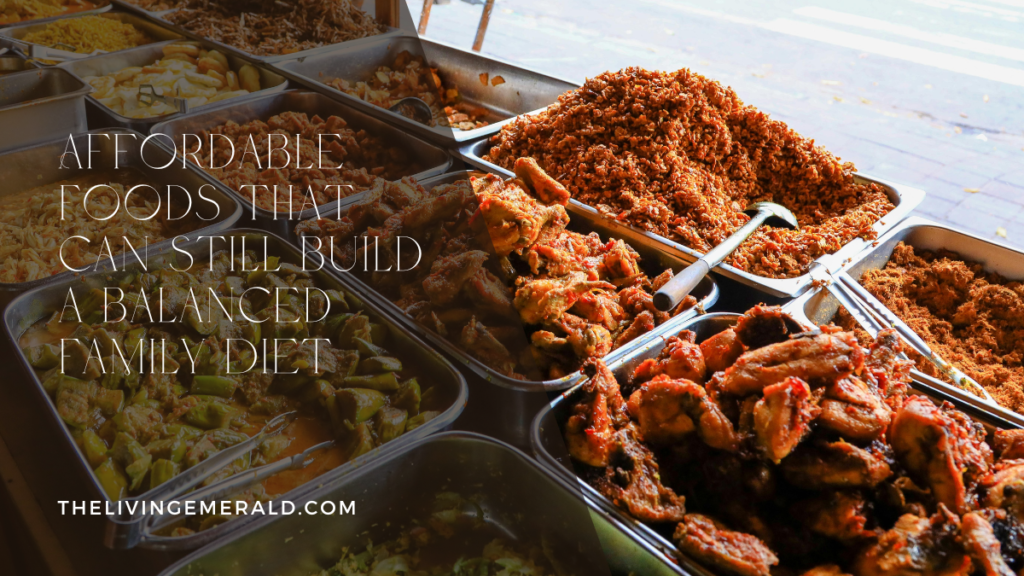
Beans, groundnut, seasonal vegetables, and locally available proteins are often both the cheapest and most nutritionally dense options on a Nigerian table — it’s usually convenience food, not traditional food, that costs more while offering less. A pot of beans with palm oil and pepper, a groundnut-based soup, or a vegetable stew built around what’s in season can carry a family through several meals for a fraction of the cost of pre-packaged alternatives, while offering more actual nourishment. The World Health Organization notes that a diet built around minimally processed, whole foods like these remains one of the most reliable ways to protect a family’s long-term health, regardless of budget.
The barrier isn’t usually the food itself. It’s the planning around it — knowing what’s in season, buying in the right quantities, and having a simple enough process that it doesn’t require a free afternoon every single day.
Making the process part of the value
That Saturday with the groundnut worked partly because the process itself became something the children participated in, not just a meal that appeared in front of them. Sorting, preparing, and cooking together turned a budget-conscious choice into a life-skills lesson and a shared memory, at no extra cost. Affordable food doesn’t have to be rushed or joyless — sometimes the slower, cheaper option is also the more connecting one, simply because it takes long enough for people to be present together while it happens.
Five affordable Nigerian staples worth building meals around
- Beans and locally grown legumes
- Fresh groundnut
- Seasonal vegetables from the local market
- Palm oil-based stews with modest protein
- Whole grains like rice and garri prepared at home rather than pre-packaged snacks
A practical starting point
Pick one traditional, affordable staple your family already likes — beans, groundnut, a favorite local vegetable — and build one meal a week around it deliberately, ideally with the children involved in some part of the preparation. Buy what’s in season rather than what’s convenient at that moment. Compare, honestly, what a home-prepared version costs against the packaged equivalent it would replace; the gap is often larger than expected.
None of this requires perfection or a complete overhaul of how a family eats. It requires noticing that the foods already available, affordably, in a Nigerian market are frequently the same foods that build a genuinely balanced diet. Cheap does not have to mean poor, and sometimes the more affordable choice is also the better one.
Related Reading
This connects to Healthy Eating When Money and Time Are Tight and How to Feed a Family Without Letting Food Spending Run Wild.