The Whole Woman

A space for the experiences, thoughts, struggles, victories and questions of women. The Whole Woman looks beyond the roles of wife and mother to explore womanhood, identity, faith, motherhood, marriage, work, purpose, friendships, personal growth, emotional life and the things women do not always say aloud.

how to ask for help when you're used to doing it all

How to Ask for Help When You’re Used to Doing It All

Learning how to ask for help when you’re used to doing it all starts with noticing the belief underneath the independence. If you’ve spent years being the one who handles things, asking for help can feel almost physically uncomfortable — not because you don’t need it, but because doing it all has quietly become part of how you see yourself. Notice the Belief Underneath the Independence Often, difficulty asking for help isn’t really about capability — it’s a belief that needing help makes you less reliable, or a burden, or somehow lesser than the version of you that manages everything alone. That belief rarely survives being said out loud, even just to yourself. Start With Small, Specific Requests “Can you help me with everything” is hard to ask and hard to answer. “Can you pick up the kids on Tuesday” is specific, low-stakes, and much easier both to request and to receive. Practicing on small, concrete asks makes the larger ones easier when you actually need them. Let People Help Imperfectly Part of what keeps capable women from asking for help is the belief that it won’t be done the way they’d do it — which is often true, and also not actually the point. Accepting help that’s done differently, not worse, just differently, is part of what makes asking sustainable rather than a one-time exception. Asking for help isn’t an admission that you can’t manage. It’s a recognition that you shouldn’t have to manage everything alone just because you’ve proven, for years, that you could. How to Ask for Help When You’re Used to Doing It All: Separate Capability From Obligation Being able to do everything yourself and being required to do everything yourself are two different things, even though they can feel identical after years of practice. How to ask for help when you’re used to doing it all starts with being honest about that difference — just because you can carry something alone doesn’t mean carrying it alone is the better choice. Let Go of Needing It Done Your Way Part of what keeps capable women doing everything themselves is an unspoken requirement that help only counts if it’s done exactly the way they would do it. Loosening that standard, even slightly, opens up far more help than most women realize was available. A spouse who folds laundry differently, a friend who cooks a different way, a child who cleans imperfectly but genuinely helps — all of it still counts. Practice Receiving Without Immediately Repaying Many women who struggle to ask for help are comfortable giving it but uncomfortable receiving it without evening the score right away. Let at least one offer of help stand without rushing to return the favor immediately. Receiving graciously, without guilt, is its own skill, and one worth building deliberately as part of how to ask for help when you’re used to doing it all. Asking for help is not a step back from capability — it’s often the thing that makes capability sustainable over the long run instead of something that quietly burns out. If burnout already feels close, HelpGuide’s guide to recognizing and recovering from it is worth reading alongside this, and if confidence has taken a hit from carrying so much alone, rebuilding confidence after a hard season and repairing strain in a marriage from built-up resentment are both closely related reads. Ask for the Specific Thing, Not the Vague Favor “Can you help me” is harder to act on than “can you pick the kids up at four on Thursday.” Vague requests put the burden back on the other person to guess what’s actually needed, and often go unanswered simply because nobody knew where to start. Knowing how to ask for help when you’re used to doing it all often just means practicing the specific version of the ask, out loud, before the moment you actually need it.

How to Ask for Help When You’re Used to Doing It All Read More »

The Whole Woman
rebuilding your confidence after a hard season

Rebuilding Your Confidence After a Hard Season

Rebuilding your confidence after a hard season doesn’t mean getting back to who you were before it. A hard season — loss, a health scare, a relationship ending, years of just surviving — doesn’t just take time and energy. It quietly takes confidence too, in ways you might not notice until you try to do something that used to feel easy and it doesn’t anymore. Confidence Doesn’t Return All at Once It’s tempting to wait to feel confident again before doing the things confidence used to make easy. In practice, it usually works the other way — small actions, taken before the confidence has fully returned, are what actually rebuild it. Waiting to feel ready often means waiting indefinitely. Start With Decisions That Are Low-Stakes After a hard season, even small decisions — what to cook, what to wear, how to spend an afternoon — can feel strangely heavy, because decision-making itself got worn down along with everything else. Practicing on the low-stakes decisions rebuilds the muscle before you need it for the bigger ones. Let Evidence, Not Memory, Rebuild the Belief You don’t have to feel as confident as you did before the hard season to start again — you just need enough evidence, collected one small success at a time, that you can still do hard things. Each time you follow through on something you weren’t sure you could, that becomes real evidence, not just a hope. Confidence after a hard season isn’t about getting back to who you were. It’s about proving to yourself, one action at a time, who you still are. Rebuilding Your Confidence After a Hard Season: Grieve What It Took First It’s tempting to skip straight to rebuilding, but confidence rebuilds slower when the loss underneath it hasn’t been acknowledged. Whatever the hard season cost you — a relationship, a role, a version of yourself you liked — give yourself permission to name that loss honestly. Grief that’s skipped doesn’t disappear; it just shows up later, usually as self-doubt that doesn’t seem to have a clear cause. This is often the real starting point for rebuilding your confidence after a hard season. Surround Yourself With People Who Remember Who You Are A hard season can make it easy to forget your own strengths, especially if the people around you only ever knew you during the hardest part of it. Spend time with the people who knew you before — who remember what you’re actually capable of. Their memory of you can hold steady while your own confidence is still catching up, even if it’s just a phone call every week. Let Small Wins Count Out Loud Write down, even briefly, the small things you get right each day during this rebuilding period — a hard conversation handled well, a boundary kept, a task finished despite not feeling like it. Confidence responds to evidence, and a private list of real wins becomes something to return to on the days memory tries to tell you otherwise. That list, more than any single moment, is what rebuilding your confidence after a hard season actually looks like. Rebuilding your confidence after a hard season isn’t about forcing yourself back to who you were before — it’s about letting the evidence of small, real wins rebuild a truer picture of who you are now. If doubt about your own decisions is still part of the daily struggle, this piece on building confidence when you doubt yourself walks through that in more depth, and if asking others for support still feels hard, learning to ask for help when you’re used to doing it all is a closely related next step. The NHS also has practical, evidence-based tips for raising low self-esteem worth reading alongside this. Small Steps for Rebuilding Your Confidence After a Hard Season Start with one task you can finish today, not the whole mountain. Rebuilding your confidence after a hard season happens through small proof points, not a single dramatic comeback.

Rebuilding Your Confidence After a Hard Season Read More »

The Whole Woman

How to Make Time for Yourself Without Guilt

Figuring out how to make time for yourself without guilt starts with understanding where that guilt actually comes from. For a lot of women, the guilt shows up before the time off even starts. You plan an hour for yourself and spend half of it mentally listing everything you could have been doing instead. The rest never quite feels restful because some part of you is keeping score. Where the Guilt Usually Comes From Often it’s not really about the hour itself — it’s a belief, picked up over years, that your worth is tied to how much you give. If you’ve spent a long time being the one everyone relies on, rest can start to feel like letting someone down, even when nothing is actually at stake. Reframe It as Maintenance, Not Indulgence You wouldn’t feel guilty charging your phone — you’d just accept it needs power to keep working. Treating your own rest the same way, as basic maintenance rather than a reward you have to earn, changes how it feels to take it. The people who depend on you are better served by a version of you that isn’t running on empty. Start With Something Small and Unapologetic You don’t need a spa day to prove the point. Ten minutes with a closed door and no explanation given. A walk you don’t narrate to anyone. Reading something that isn’t for anyone else’s benefit. The size of the time matters less than whether you let yourself take it without negotiating for it first. If you’ve lost touch with what even feels like yourself anymore, What to Do When You No Longer Recognize the Woman You’ve Become is a good next read. Taking time for yourself isn’t selfish — it’s what makes everything else you give sustainable. You’re allowed to want it without justifying it first.

How to Make Time for Yourself Without Guilt Read More »

The Whole Woman

How to Find Yourself Again After Years of Caregiving

If you’re wondering how to find yourself again after years of caregiving, that ache isn’t selfish — it’s worth paying attention to. Somewhere in the middle of years spent caring for everyone else, a question starts surfacing quietly: who am I, outside of what I do for other people? Not a dramatic crisis — just a small, persistent ache that shows up when you finally sit still long enough to notice it. If you’ve been carrying that question without saying it out loud, here’s the first thing worth knowing: wanting yourself back isn’t selfish. It’s actually necessary, for you and for the people you love. Caregiving Can Quietly Erase a Person Nobody decides one day to disappear into caregiving. It happens gradually — a hobby traded for a nap because there was no other time, an opinion softened to keep the peace, a dream quietly shelved “for now” that never got picked back up. Each individual trade made sense in its moment. The accumulation is what disorients you years later, when you catch your reflection and don’t quite recognize the woman looking back. This is common, not a personal failure. Years of giving, giving, giving without an equal rhythm of receiving will reshape anyone’s sense of self. The fact that you’re noticing it now, instead of five more years from now, is a good sign, not a bad one. You Were a Person Before You Were Needed “She is clothed with strength and dignity; she can laugh at the days to come” (Proverbs 31:25). This verse is often read only as a description of what a woman does for others, but notice what it actually centers: her own strength, her own dignity, her own capacity to face the future without fear. The woman described here has an identity that doesn’t collapse into her caregiving — it’s clothed in something sturdier than her roles. Whoever you were before the caregiving started — curious, funny, ambitious, creative, opinionated — that person didn’t get deleted. She got buried under years of urgent needs that weren’t hers. Finding her again isn’t a betrayal of the people who depend on you. It’s recovering the person who makes your care for them sustainable instead of resentful. Small, Real Ways to Start Reclaim one thing that’s only yours, even if it’s small. Fifteen minutes of a hobby you dropped years ago. A book that has nothing to do with anyone else’s needs. The goal isn’t to overhaul your life — it’s to prove to yourself that something is still yours alone. Say one honest opinion out loud this week, even a small one, that you’d normally soften or skip to avoid friction. Practice having a voice again in low-stakes moments before you need it in the high-stakes ones. Ask yourself what you actually wanted, before you adjusted your wants to fit everyone else’s needs. You don’t have to act on the answer yet. Just let yourself remember it exists. This Isn’t the End of Who You Were You haven’t lost yourself permanently — you’ve been living in a season that asked almost everything of you, for a long time. Seasons change. The woman you were is still in there, and she’s not waiting for permission to come back. She’s waiting for you to make a little room for her again. If part of what you’re facing right now is specifically the identity shift of becoming “mom” first and yourself second, What to Do When You No Longer Recognize the Woman You’ve Become goes deeper into that exact season.

How to Find Yourself Again After Years of Caregiving Read More »

The Whole Woman

Deborah: A Woman Extraordinaire

Who Was Deborah? Deborah was an extraordinary figure in biblical history, serving ancient Israel as a prophet, judge, military leader, songwriter, and minstrel. Residing in Ephraim, she judged and led Israel for 60 years in the 12th century B.C., which included 20 years of national hardship before the Canaanite war and a peaceful 40 years after. As a prophetess, Deborah received messages from God and shared them with the people. She was also a judge, settling disputes between Ramah and Bethel in the land of Ephraim. The Bible says she would sit under a palm tree, later known as Deborah’s Palm, for people to come to her with their issues. During Deborah’s time, the Israelites were oppressed by Jabin, the king of Canaan. Stirred by the wretched condition of Israel, Deborah sent a message to Barak, the son of Abinoam, and told him that the Lord God had commanded him to muster ten thousand troops of Naphtali and Zebulun and concentrate them upon Mount Tabor. She prophesied that God would draw Sisera, the commander of Jabin’s army, to the Kishon River, where Barak would defeat him. Barak was hesitant and said he would only go if Deborah went with him. Deborah agreed but prophesied that the honor of defeating Sisera would then belong to a woman. When Sisera heard about the rebellion, he gathered nine hundred chariots of iron and a host of people. Deborah then told Barak, “Go! This is the day the Lord has given Sisera into your hands. Has not the Lord gone ahead of you?”. A battle ensued, led by Barak, and Sisera was completely defeated. Sisera fled on foot and sought refuge in the tent of Jael, the wife of Heber the Kenite. Jael welcomed Sisera, gave him milk, and covered him with a blanket. While he slept, Jael took a tent peg and hammered it through Sisera’s temple, killing him. After the battle, Deborah and Barak sang a song of victory and praise, recorded in Judges 5. The biblical account of Deborah concludes with the statement that after the battle, there was peace in the land for 40 years. Deborah’s leadership exemplified moral character, and she was greatly respected by the people. Modern women can glean wisdom from Deborah’s actions in several key areas: Lessons Modern Women Can Learn From Deborah For more biblical women’s studies, listen to the Women Extraordinaire Podcast: Treasure in Jars of Clay and Women Extraordinaire Podcast: The Potter and the Clay. You can also read more about Deborah’s story at Bible Study Tools.

Deborah: A Woman Extraordinaire Read More »

The Whole Woman
Restarting Your Career After Motherhood

Restarting Your Career After Motherhood: 5 Steps That Work

Restarting your career after motherhood can feel like standing at the bottom of a staircase you climbed years ago. The world of work has changed, your children need you, and a quiet voice asks whether anyone will want to hire you after a break. That voice is wrong more often than it is right. The years you spent raising children built patience, planning, negotiation, and resilience. This article offers five steps for restarting your career after motherhood, and you can pair it with our page of prayer points for career breakthrough when you need courage. Why Restarting Your Career After Motherhood Feels So Hard Confidence is usually the first obstacle. After years at home, or years of part-time work around the children, it is easy to believe your skills have expired. Guilt is the second obstacle. Many mothers worry that returning to work means loving their children less. Neither belief is true. Work can be one way you provide for your family and use the gifts God gave you. Naming the fear is the first step to dealing with it. You are not behind. You are beginning a new chapter. 1. Take Stock of What You Bring Sit down with a pen and list everything you have done in the last few years: managing a household budget, organising school events, volunteering at church, running a small side business, caring for a family member, or learning something new. List paid and unpaid work. Then translate each item into skills an employer understands, such as budgeting, coordination, communication, leadership, and problem solving. This list becomes the raw material for your CV and for how you speak about yourself in interviews. 2. Decide What Kind of Work Fits This Season Not every mother wants the same thing. Some want full-time work, some want flexible hours, and some want to start a small business from home. Think about your children’s ages, your support at home, and what income your family really needs. Be honest and specific. Write down the hours you can work, the distance you can travel, and the minimum income you need. A clear picture prevents you from chasing roles that will only leave you exhausted. If you feel drawn to a new direction altogether, our reflection on why a woman may push for a new beginning may resonate. 3. Refresh Your Skills Choose one or two skills to update. That could be basic computer skills, a professional certificate, a short online course, or simply practising a tool your industry now uses every day. Small, focused learning is better than a long list you never finish. Many free and low-cost courses exist online, and you can study in the gaps of your day. Finishing something also rebuilds confidence, because it reminds you that you can still learn and grow. 4. Rebuild Your Network Most opportunities come through people. Message former colleagues, classmates, church friends, and neighbours, and tell them plainly what kind of work you are looking for. You do not need a long speech. A short message such as “I am returning to work in accounting and would value any leads” is enough. Ask for advice as well as jobs. People enjoy helping when the request is clear and small. Keep a simple list of everyone you contact and follow up kindly. 5. Look After Your Money and Your Worth When you restart, you should also protect your own financial footing. Talk with your spouse, if you are married, about how income, savings, and responsibilities will be shared. Our reflection on why a woman’s savings matter explains why this is not selfish. The woman described in Proverbs 31:16-18 considers a field and buys it, and sees that her trading is profitable. Diligence and good judgement in work have always been part of a godly woman’s life. Handling the Gap on Your CV Many mothers worry most about the gap in their work history. You do not need to hide it or apologise for it. State it plainly and briefly: “I took time to raise my children and I am now returning to work.” Then move straight to what you bring and what you have been doing to prepare. If you volunteered, took courses, ran a small business, or helped manage a household or an organisation, include it under its own heading. Employers respect honesty and readiness far more than a perfect timeline. When you are restarting your career after motherhood, the way you talk about your break matters as much as the break itself. Practise your short answer out loud until it feels natural. A calm, confident sentence at the start of an interview settles both you and the interviewer. Sort Out Childcare and Support Early A plan for the children makes everything else easier. Decide who will help, whether it is a spouse, a relative, a trusted neighbour, or paid care, and test the arrangement before you begin. Have a back-up for the days a child is sick or school closes unexpectedly. Speak with your family about what will change at home. Sharing tasks openly avoids a slow build-up of resentment. Restarting your career after motherhood works best when the household adjusts with you, instead of expecting you to do everything as before. Pray Over the Decision Bring the whole decision to God, including your fears about your children and your worth. Ask Him for wisdom about the kind of work, the timing, and the people to approach. Then take the next small step with peace. You are not choosing between faith and work. You are asking God to lead you in both. Give Yourself Grace and Time Restarting your career after motherhood rarely happens in a straight line. You may get rejections, you may take a role that is smaller than you hoped, and you will have days when childcare falls apart. None of that means you have failed. Celebrate small wins: the first message answered, the first interview, the first day back. And remember that you are


Restarting Your Career After Motherhood: 5 Steps That Work Read More »

The Whole Woman
Don't Reduce Her to Support

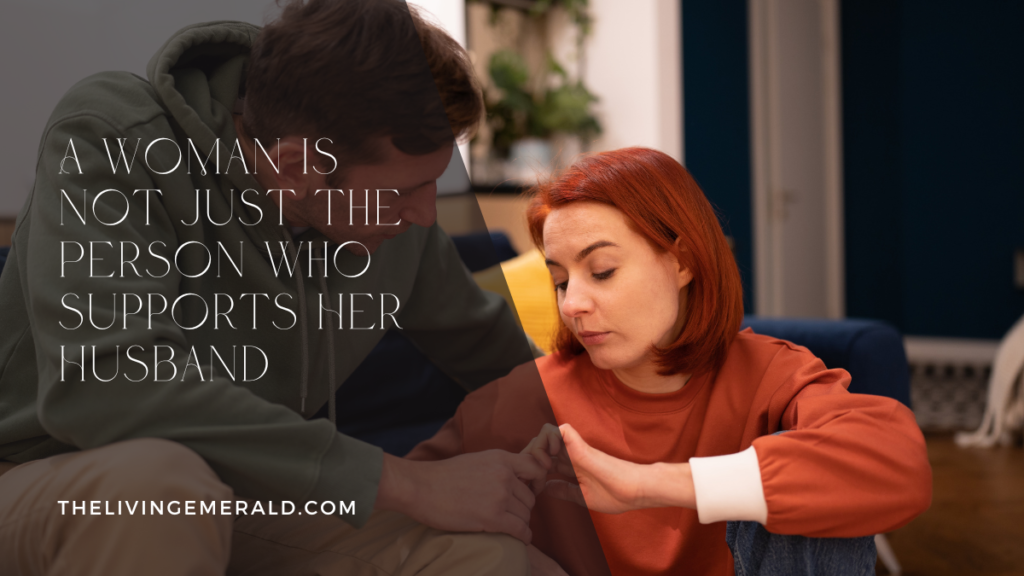
A Woman Is Not Just the Person Who Supports Her Husband

Many husbands would say, sincerely, that they appreciate how much their wives support them. The meals, the encouragement, the sacrifices and the quiet steadiness at difficult moments are real, and they deserve thanks. Yet there is a subtle danger inside that gratitude. When support becomes the only lens, a woman gets reduced to her usefulness. Don’t reduce her to support: she is a whole person with her own life, her own calling and her own agency. I write as a married husband and father, not as someone who can speak for women or claim to know how womanhood feels from the inside. What I can offer is a husband’s honest reflection on a habit many men fall into without meaning to. I will not describe private details of any marriage. The aim is to help men see the whole woman beside them and to give women room to be seen that way. How a Wife Slowly Becomes “the Supporter” It rarely happens by decision. It happens by default. A husband’s career, ministry or business grows, and the household arranges itself around it. The wife adjusts her schedule, postpones her plans and covers the gaps. Everyone praises her for being supportive, and over time nobody asks what she herself wants. Her goals become optional, and his become the family’s. Introductions reveal it. “This is my wife” is true and warm, but if it is the only way she is ever described, it quietly erases her name, her work and her interests. A woman is not an accessory to a man’s story. She has her own. Don’t Reduce Her to Support: Why It Matters When a wife is reduced to support, both people lose. She loses the space to develop her gifts and to be known for more than her usefulness. He loses a real partner, because a partner is someone with her own ideas, disagreements and vision, not simply someone who reinforces his. A marriage where one person’s identity is absorbed by the other is thinner for both. It also affects children. Daughters especially watch how their mother is treated, and sons learn what a wife is for. Seeing a mother who is respected as a full person teaches them what respect looks like at home. What Scripture Suggests About Her Agency The Bible’s portrait of a capable woman in Proverbs 31 describes someone who “considers a field and buys it,” works with vigour, manages resources and speaks with wisdom (Proverbs 31:16-26). She is praised for her initiative, not merely for propping up her husband. The word often translated “helper” in Genesis 2:18 is also used elsewhere in Scripture of God himself as our helper, which suggests that “helper” is not a word for someone lesser. These are interpretive points, held with care, but they point away from reducing a wife to a supporting role. Five Powerful Reminders for Husbands None of these requires a grand gesture. They are habits of attention and respect, repeated over time. Ask the Question She May Be Waiting For Try this question soon: “What do you want for yourself in this season, and how can I help make room for it?” Then listen carefully, and follow up with action. Writers on women’s economic and social empowerment, including UN Women, consistently link women’s agency to the wellbeing of families and communities, which reminds us that this is not a private favour but a shared good. If she has been putting her plans aside for years, the answer may come slowly. Be patient, and do not rush to fix. Our article on when she wants change speaks to seasons when a woman’s hopes are shifting. Small Ways the Reduction Shows Up It is worth noticing the small, everyday ways a wife gets reduced to her supporting role. She is thanked for helping with his event but not asked about her own week. Her time is treated as flexible while his is protected. Family decisions are built around his schedule and she is expected to adapt. Each instance may look harmless, yet together they tell her that her own plans are secondary. To not reduce her to support means catching these moments and choosing differently. It also means asking who benefits from the current arrangement, and being honest about the answer. If most of the flexibility comes from one person, it is worth talking about, kindly and without accusation. Don’t reduce her to support by accident: notice the pattern, name it together and adjust. Support Is Not the Enemy Nothing here is against supporting each other. Marriage involves mutual support, and both spouses give and receive it. The problem is when support flows one way, or when it becomes the only thing a woman is valued for. A healthy marriage makes room for both people to lead, to rest and to be encouraged, sometimes in turns. Don’t reduce her to support, and don’t reduce yourself to a provider either. See the Whole Woman This week, notice how you speak about your wife, in conversation and in your thoughts. Is she the person who helps you, or a person you are curious about? Talk with her about the parts of her life that have little to do with you. Read why a woman is more than wife and mother together, and why her savings matter if money is part of her story. When you see the whole woman, you begin to build the kind of partnership both of you hoped for. So the reminder stands: don’t reduce her to support. She was never only there to make your life easier. Say it to yourself when you catch the old habit, and don’t reduce her to support in your words, your plans or your assumptions.

A Woman Is Not Just the Person Who Supports Her Husband Read More »

The Whole Woman
A Husband's View of His Wife

What Men Need to Understand About the Woman Beside Them

A husband’s view of his wife is usually shaped by what he sees each day: the meals, the school run, the messages answered, the household running. It is easy to mistake that visible activity for the whole person. Yet the woman beside you has an inner life, ambitions, fears and a history that exist well beyond her roles. This article is an attempt, from a husband’s side, to describe what men often need to understand. I write as a married husband and father, not as someone who can claim to know what womanhood feels like. I cannot speak for women, and I would not try to. What I can offer is a husband’s perspective on where men tend to miss things, and an invitation to ask the woman beside you rather than assume. Private details of any marriage, including my own, stay private. She Is More Than the Roles She Fills A wife is often also a mother, a worker, a daughter, a friend, a church member and a household manager. It is natural for a husband to see her through the role that touches him most. But roles are not the person. She has interests that existed before you met and dreams that are still alive, even if they have been pushed down by responsibility. When a man only sees the roles, he tends to measure his wife by how well she performs them. A husband’s view of his wife becomes richer when he asks a different question: who is she becoming, and what does she need in order to grow? Our article on why a woman is more than wife and mother explores this from a woman’s standpoint. Five Powerful Truths Men Often Miss Not every woman will fit these descriptions, which is exactly why the most important step is to ask her. A Husband’s View of His Wife Begins With Listening The simplest way to improve a husband’s view of his wife is to listen more carefully. That means choosing a calm moment, putting the phone away and asking open questions such as, “What has been weighing on you lately?” or “What would help this week?” Then let her answer without correcting her or defending yourself. Empathy is a skill men can practise. Writers on the subject, such as those at Psychology Today’s empathy page, describe it as understanding another person’s experience from the inside, and it grows with attention and practice. It does not require you to agree with everything. It requires you to take her experience seriously. Notice the Work, Say Thank You and Share the Weight Gratitude is one of the most underrated tools in a marriage. Say thank you for specific things, not only large ones. Notice when she has planned ahead, solved a problem or carried a burden quietly. Then look for real ways to share the weight, by taking full ownership of tasks and not merely helping when asked. If money is part of her stress, take it seriously. Our piece on why her savings matter considers financial security from a woman’s point of view, and when she wants change speaks to seasons when a woman’s hopes are shifting. Balanced Empathy Works Both Ways Understanding your wife does not mean neglecting your own needs or pretending you have none. Healthy marriages have room for both people to speak. A husband’s view of his wife is most accurate when it is balanced: generous toward her, honest about himself, and open to correction. Speak about your own pressures calmly, and let her respond as well. It also means avoiding the temptation to make yourself the hero or the victim. The goal is not a perfect husband. It is a curious, humble one who keeps learning the woman he married. What She May Need You to Understand About Pressure Many women live with a steady background of pressure that is not always visible: to look after everyone, to keep the home running, to meet family expectations, to work and still be present. Some of that pressure is loving. Some of it is unfair. A husband who learns to recognise it can begin to ease it, simply by not adding to it and by offering practical relief without waiting to be asked. Ask what she would like to hand over, not what you could help with. The difference matters. Handing over a task means it is off her mind completely, and that is where real rest begins. It is also a quiet way of telling her that you see how much she carries. Keep Learning Her, Even After Years Together People change. The woman you married years ago has grown, and so have you. A husband’s view of his wife can go stale if it is never updated. Make it a habit to ask fresh questions and to be curious about what has changed: her goals, her worries, what she enjoys now. Marriage stays alive when both people keep discovering each other, and a husband who is still learning his wife shows her that she is still worth knowing. One Question to Ask This Week Pick one open question and ask it this week, then listen without interrupting. You might ask what she is proud of, what she is worried about, or what she would like more of in her week. A husband’s view of his wife grows one honest conversation at a time, and she will very likely notice the effort.

What Men Need to Understand About the Woman Beside Them Read More »

The Whole Woman
Shopping Cart
Scroll to Top