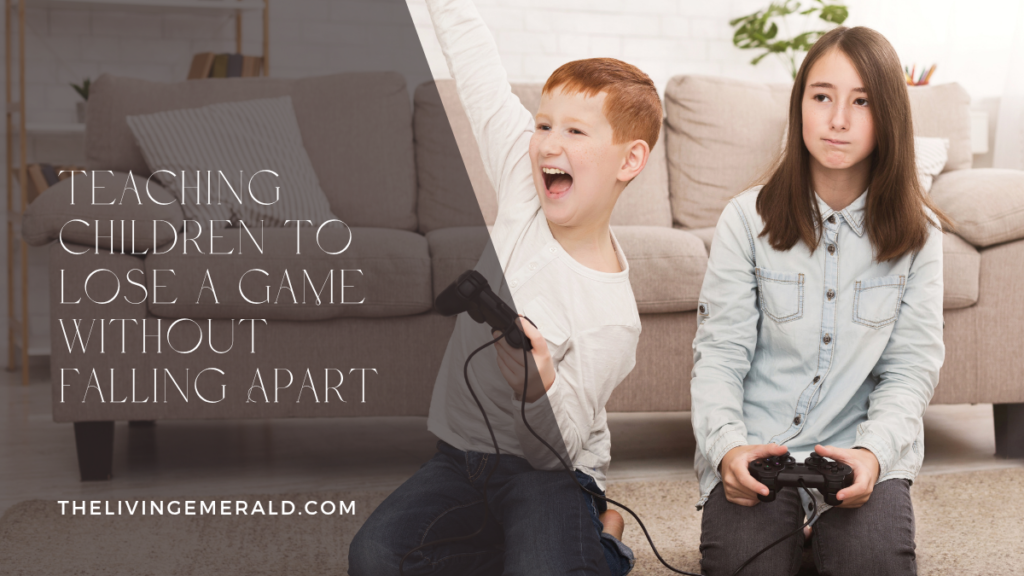
Teaching children to lose a game without falling apart is a real, learnable skill — not a personality trait some kids simply have and others don’t. Board game night ends in tears more often than most parents would like to admit. A missed goal, a lost round of Uno, a sibling who finished the puzzle first — and suddenly you have a child who is sobbing, or storming off, or insisting the game was rigged.
It’s tempting to read this as bad sportsmanship that needs correcting on the spot. It’s more useful to read it as a skill that hasn’t been built yet — because that’s closer to what’s actually happening.
Why Losing Feels So Big to a Child
Young children have a much less developed capacity to regulate disappointment than adults do, simply because the parts of the brain responsible for that regulation are still under construction well into adolescence. A loss that an adult shrugs off in seconds can genuinely feel, to a six-year-old’s nervous system, as significant as it looks on their face.
Competitiveness itself isn’t the problem. Wanting to win is a healthy, normal response. The problem is that many children haven’t yet been taught what to do with the feeling of not winning, because the moment usually gets managed by the adults around them instead of practiced by the child.
Don’t Rush to Fix the Feeling
The instinct to immediately cheer a child up after a loss — “it’s okay, you’ll win next time,” “let’s play again so you can win” — often teaches the opposite of what’s intended. It signals that the feeling of losing is something to be avoided or quickly erased, rather than something that can be felt and moved through.
A more useful first response is naming the feeling without rushing to resolve it: “You really wanted to win that one. It’s disappointing.” Let that sit for a moment before offering anything else. Children build emotional vocabulary largely by hearing their feelings named accurately by the adults around them.
Model Losing Before You Correct It
Children learn far more from watching how adults handle losing than from being told how to handle it. If you play games with your child, let yourself actually lose sometimes, and narrate your own response out loud: “Aw, I lost that round. Oh well — good game. Let’s go again.” That running commentary teaches the script more effectively than any lecture delivered after a meltdown.
This matters especially for the parent who tends to let children win every round to avoid tears. It feels kind in the moment and removes the exact practice the child needs — losing in a low-stakes setting, with a calm adult nearby, before they have to do it in a higher-stakes one like a school competition or a sports match.
Set the Expectation Before the Game Starts
A short, calm conversation before play begins does more than any correction during or after it: “In this game, someone wins and someone doesn’t, and that’s true every time we play. If you lose, you can feel disappointed, and we’re still going to say ‘good game’ to each other.” Stating it in advance, when no one is upset yet, makes it far easier to hold the line calmly if a meltdown does happen.
What to Do in the Moment It Falls Apart
If a loss does end in tears or anger, stay calm rather than matching the intensity. Give the feeling room — “I can see you’re really upset” — without lifting the consequence or ending the game early to soothe it. If a child throws pieces or is unkind to the winner, that behavior still gets addressed, separately from the disappointment itself: the feeling is always allowed; not every response to the feeling is.
Over many repeated, low-stakes losses handled this way, most children do build the skill of losing gracefully. It rarely happens from one conversation — it happens from the accumulated evidence, across dozens of games, that losing is survivable and that the people around them stay steady through it.
For more on helping children manage big emotions without shutting them down, see Your Child Is Not Misbehaving Every Time They Have Big Feelings.