
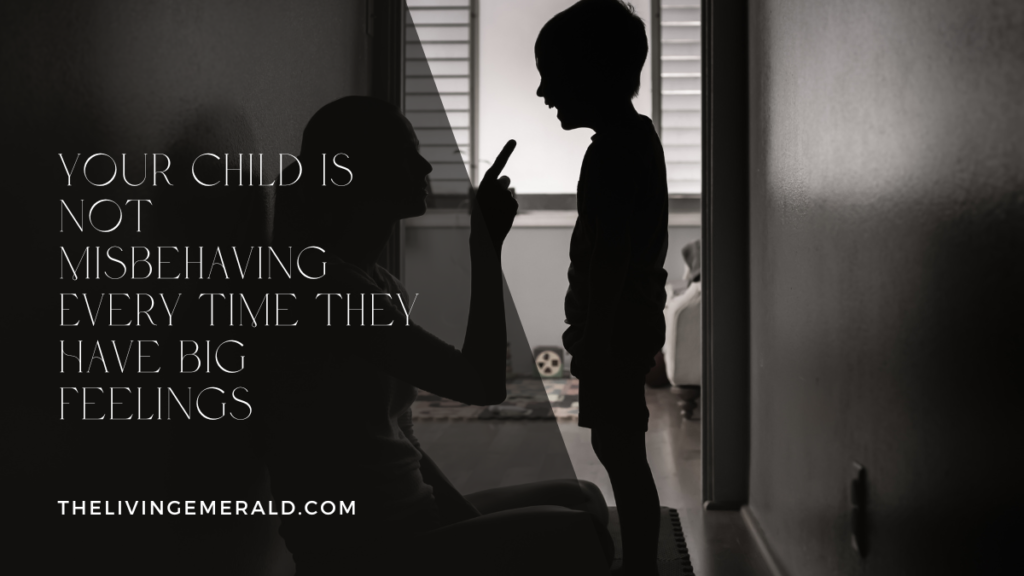
A child slams a door, cries over a broken biscuit or refuses to leave the playground, and the adult’s first thought is often, “Why is this child behaving so badly?” Sometimes the answer is that the child is not misbehaving at all. They are overwhelmed by a feeling they cannot yet name. Teaching children to express emotions is one of the most useful things a parent can do, because a child who can say what they feel is less likely to show it through chaos.
This does not mean removing rules or excusing harmful behaviour. It means separating two things that often get tangled: the feeling, which is always allowed, and the behaviour, which may need limits. This article offers practical language and routines for both. It is general parenting guidance, not a diagnosis, and every child develops differently.
Big Feelings Are Not the Same as Bad Behaviour
Young children have big emotions and small tools for managing them. Their brains are still developing the skills of pausing, naming and calming. When frustration, disappointment or fear arrives, it comes out through the body: tears, shouting, throwing, hitting or going silent. That is communication before it is misconduct.
A helpful question is, “What is this behaviour telling me?” It might be tiredness, hunger, a change in routine or a feeling the child does not understand. Asking this does not remove consequences for harmful actions. It helps you respond to the cause and not only the noise.
Teaching Children to Express Emotions Step by Step
Emotional skills are learned the way any skill is learned, through repetition, patience and example. Here are five steps to build them into ordinary days:
- Name the feeling. Say simply, “You look upset,” or “That was disappointing.” Naming gives the child a word for something that felt shapeless.
- Accept the feeling, limit the behaviour. “You are allowed to be angry, and you are not allowed to hit.” Both halves matter.
- Offer a way to express it. Words, drawing, a stomp in the garden or a few deep breaths can all move a feeling without harm.
- Model it yourself. Say aloud, “I am feeling frustrated, so I will take a moment.” Children learn most from what they see.
- Repair afterwards. Once everyone is calm, talk briefly about what happened and what could be tried next time.
Wait for Calm Before You Teach
A child in the middle of a meltdown cannot take in a lesson. Explanations, reasoning and consequences land better after the storm has passed. In the moment, your job is to stay steady, keep everyone safe and use few words. Sit nearby, speak quietly and let the feeling pass through.
Later, when things are calm, you can revisit it gently: “You were very upset earlier. What do you think you needed?” Over time, these conversations build the habit of reflection.
Give Children the Words
Many children simply lack a vocabulary for emotions. Go beyond “happy,” “sad” and “angry” by introducing words like frustrated, nervous, disappointed, proud, embarrassed and left out. Stories and pictures make this easier: pause a story to ask how a character might feel and why. A simple feelings chart on the wall can help younger children point when words are hard to find.
Routines help too. A short bedtime check-in, such as “What was the best part of today, and what was the hardest part?” gives feelings a regular place to be spoken. Guidance from organisations like HealthyChildren.org emphasises the value of consistent, warm communication in raising emotionally healthy children.
Ideas for Different Ages
Teaching children to express emotions looks different at each stage. With toddlers, keep it simple: name one feeling at a time, use short sentences and stay close. With children of school age, add feelings vocabulary, drawing or storytelling, and talk about strategies such as taking a breath or asking for space. With older children and teenagers, listen more than you speak, respect their privacy, and let them know they can come to you without being lectured.
Whatever the age, the pattern stays the same: acknowledge the feeling, hold the limit and offer a way through. Teaching children to express emotions is not a one-time lesson. It is a habit built in thousands of small moments, and it is one of the best gifts you can give a child for the rest of their life.
Keep the Boundaries Clear
Emotional acceptance is not the same as permissiveness. Children feel safer when limits are clear and consistent. If a child throws something, the feeling was allowed and the throwing still needs a consequence, delivered calmly. The consistent message is: I understand you, and this is how we behave in our family.
If you are working out how to balance warmth and limits, teaching children responsibility and children and repeated questions offer related, practical ideas.
When to Seek Extra Support
Most big feelings are a normal part of growing up. If a child’s distress is intense, lasts for a long time, interferes with school or friendships, or worries you, speak with a paediatrician, teacher or qualified professional. Asking for help is a sign of care, not failure, and this article is not a substitute for that advice.
Start small this week. Choose one feeling word to use often, and one moment each day to practise naming a feeling together. Teaching children to express emotions is a slow, patient process, and every calm conversation is a step toward a child who understands themselves and feels understood.
Keep going. Teaching children to express emotions takes years, not weeks, and setbacks are part of the process. Each time you calmly name a feeling, you are teaching children to express emotions a little better.