
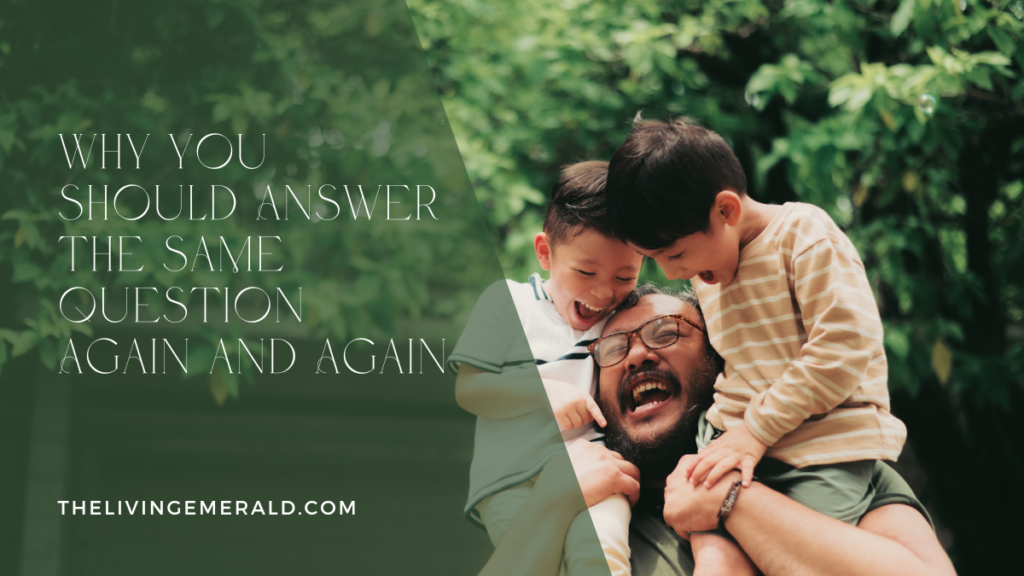
Answer the same question again and again is not a phrase that sounds like good parenting advice at first. It sounds like patience running thin. But somewhere in the middle of a season where your child asks “why?” for the fortieth time in one afternoon, or repeats the same question about the same thing every single night, something worth noticing is happening.
Why Children Answer the Same Question Again and Again — By Asking It
Children don’t repeat questions because they weren’t listening the first time. They repeat them because they are testing whether the answer is still true, still safe, and still theirs to hold onto. A four-year-old asking “will you always come back?” every single bedtime isn’t failing to remember the answer — they’re checking that the world is still steady.
This is a normal, well-documented part of how children process new information and manage uncertainty at different developmental stages, as early-childhood development research explains. The question isn’t really about information. It’s about reassurance.
Older children do this too, just less obviously. A ten-year-old repeatedly asking about a move, a divorce, or a change at school isn’t stuck on the facts — they’re checking, again and again, whether the emotional ground underneath them is still solid.
What Changes When You Answer the Same Question Again and Again With Patience
It would be faster to say “I already told you” and move on. But a parent who is willing to answer the same question again and again — calmly, consistently, without irritation — is teaching something deeper than the answer itself. They are teaching a child that their questions are welcome, that curiosity won’t be punished, and that the adults around them can be trusted to stay steady even when asked the same thing for the tenth time.
This matters even more during a season the child cares about — a birthday coming up, a house move, a new sibling. Repeated questions tend to cluster around the things that matter most to them right now. A child who feels safe asking the same question ten times is far more likely to keep bringing hard questions to a parent later — during the teenage years, when the questions get harder and the stakes get higher.
When the Repetition Actually Wears You Down
It’s worth being honest: some days, the fortieth “why” really does test the limits of patience, and that’s a normal response, not a parenting failure. The goal isn’t superhuman calm on every occasion. It’s a general pattern over time where curiosity is met more often with warmth than with irritation — not a perfect record with no bad afternoons.
A Practical Way to Hold Onto Patience
When the same question comes around again, it can help to answer it as if it’s the first time you’ve heard it — briefly, warmly, without a sigh attached. If the repetition is wearing you down, it’s fair to name it honestly: “I love that you’re curious about this. Let’s talk about it once more, and then let’s do something else together.” Naming your own limit out loud, kindly, teaches a child something valuable too — that honesty about tiredness doesn’t have to come with rejection.
You will not get every one of these moments right, and that’s fine. What matters is the pattern over time, not any single tired evening. Choosing to answer the same question again and again is one of the quieter, less celebrated ways fatherhood actually shows up.
What This Teaches Beyond Childhood
The habit of patiently answering the same question again and again doesn’t just shape a child’s early years — it shapes the kind of adult relationship you eventually have with them. Children who grew up feeling safe enough to ask the same thing repeatedly tend to become adults who still bring hard, unresolved questions back to their parents instead of working through them alone or with strangers. That outcome is built years in advance, one repeated bedtime question at a time.
Related Reading
See also The Father Who Is Always Working and Your Kids Need Your Voice.