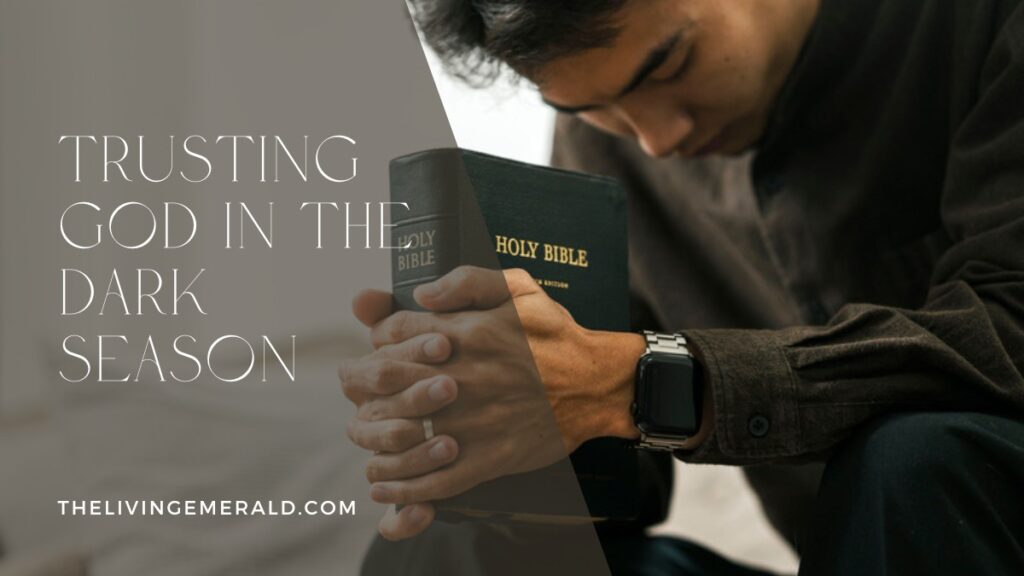

If you’ve ever wondered how to pray when you don’t know what to say, you’re not alone — and it doesn’t mean you’re doing it wrong.
Some of the most honest prayers you’ll ever pray don’t have words. You sit down, or kneel, or lie face-down on the floor, and nothing comes. Not because you don’t care, but because the thing you’re carrying is too big, too tangled, or too raw to turn into sentences.
If that’s where you are right now, here’s what’s worth knowing: that isn’t a failure to pray. It might be the most honest prayer you’ve prayed in months.
You Don’t Have to Find the Words
“In the same way, the Spirit helps us in our weakness. We do not know what we ought to pray for, but the Spirit himself intercedes for us through wordless groans” (Romans 8:26). This verse exists because the writer assumed believers would hit exactly this wall — a real need, and no language for it. The promise isn’t that God needs your eloquence. It’s that the gap between what you feel and what you can say is already covered.
Hannah, in the Old Testament, prayed so wordlessly that the priest watching her thought she was drunk — her lips were moving but no sound came out (1 Samuel 1:12-13). She was pouring out years of grief with no formula, no clean sentences. That counted as prayer. It was, in fact, one of the most answered prayers in Scripture.
Start With What’s Actually True
“Trust in him at all times, you people; pour out your hearts to him, for God is our refuge” (Psalm 62:8). Not pour out your polished thoughts — your heart, however messy that is right now. If the only honest sentence available to you is “I don’t know what to say” or “I’m angry and I don’t know why,” that’s a real prayer. Start there instead of waiting for something that sounds more spiritual.
A short, honest prayer isn’t a lesser prayer. Nehemiah, standing in front of a king who could have had him killed for looking sad, “prayed to the God of heaven” in what was likely a few silent seconds before answering (Nehemiah 2:4-5). The prayer that changed the course of a nation’s history may have taken less time than it takes to read this sentence.
What to Do in the Actual Silence
If words genuinely won’t come, try one of these instead of forcing a sentence:
Say the one true thing you do feel, even if it’s small: “I’m tired.” “I don’t understand this.” “I’m scared.” Let that be the whole prayer.
Sit in silence on purpose, without trying to fill it, and trust that being there is itself the prayer — the way sitting with a grieving friend without talking is still presence, not absence.
Borrow someone else’s words for a moment. A psalm, read slowly, can say what you can’t yet find language for. You’re not performing it — you’re letting it carry you until your own words return.
The Wordless Season Isn’t Wasted
Prayer isn’t a performance that requires the right vocabulary to count. It’s closer to presence than to speech. The season where you have nothing eloquent to offer is not a season where you’ve stopped praying — it’s often the season where prayer gets most honest, because there’s nothing left to perform.
If you’ve been avoiding prayer because you don’t know what to say, that’s the invitation, not the obstacle. Show up without the words. That’s enough to start.