
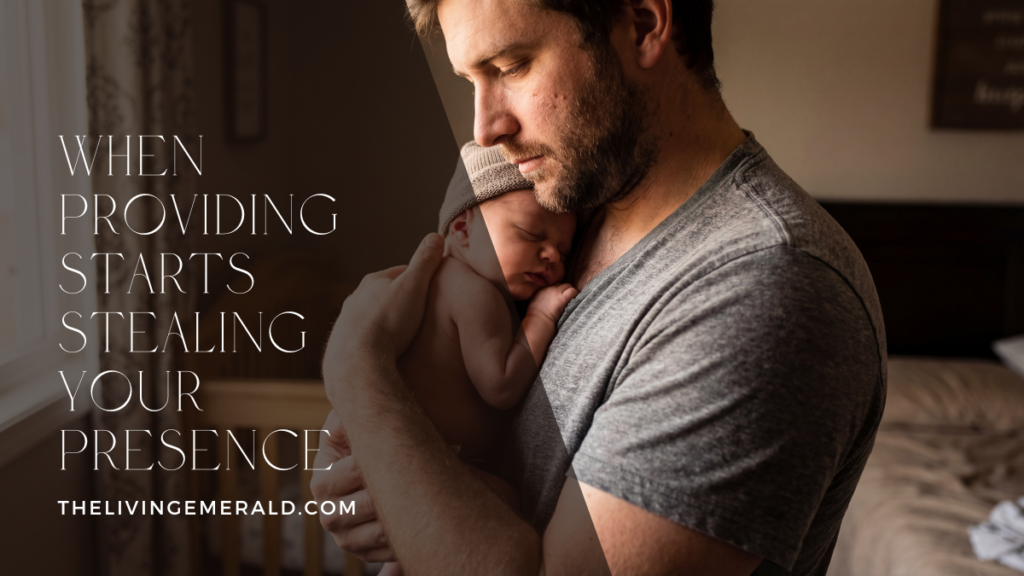
The father who is always working rarely thinks of himself that way. He thinks of himself as the one making sure the lights stay on, the school fees get paid, the orders get delivered on time. Providing feels like love in action. It takes a while to notice when it quietly starts replacing presence instead of funding it.
Running a business largely alone makes this worse, not better. There’s no shift to clock out of. The work follows you into the evening on a phone screen, and every unanswered client message feels like a small risk to the very income you’re trying to protect for your family.
The Father Who Is Always Working Still Believes He’s Choosing His Family
That’s what makes this hard to catch in the moment. Every extra hour at the desk gets justified as being for the family — and it usually is, financially. But a child doesn’t experience “for the family” as a category. They experience it as Dad being in the next room but not really there, distracted, half-listening, already thinking about the next task.
I’ve caught myself doing exactly this — physically present at the dinner table, mentally still finishing an invoice. It doesn’t feel like absence from the inside. It feels like responsibility. But from a child’s side of the table, it can look a lot like the same thing.
The Father Who Is Always Working: Provision vs. Presence
The trap is treating time as one pool that provision and presence have to fight over, so that every hour given to one is an hour stolen from the other. In practice, most days have small pockets — a car ride, a bedtime, a walk to buy bread — that provision never actually needed. It just took them anyway, out of habit, because a phone was in reach. Organizations like the National Center for Fathering point to these small, repeated moments — not grand gestures — as what actually builds a child’s sense of a father’s presence.
The Father Who Is Always Working Can Still Change
Naming specific, unmovable pockets of time — not “I’ll try to be around more,” which never survives a busy week, but a fixed slot like the school drop-off or the first twenty minutes after everyone’s home, protected the same way a client deadline would be. The phone goes somewhere else during that window, not just on silent.
It also helped to stop treating tiredness as an excuse to disengage. Some evenings there genuinely isn’t much left to give. On those evenings, saying so honestly — “Dad’s tired tonight, but I’m here” — did more for actual presence than pretending to have energy I didn’t have.
This Isn’t a Claim to Have It Figured Out
I don’t think there’s a father anywhere who’s balanced this perfectly, and I’m not writing as one. Some weeks provision wins. Some weeks presence wins. The goal isn’t a flawless ratio — it’s noticing when the scale has tipped too far for too long, and being willing to say so out loud before a child stops expecting anything different.
What My Children Would Actually Say
If asked honestly, I don’t think my children would remember the specific projects that kept me at my desk on any given evening. They’d remember whether I showed up for the things that mattered to them at the time — a school event, a game, a random Tuesday conversation about nothing important. That’s a humbling thing to sit with, because it means most of what feels urgent at work is invisible to them, and most of what feels small to me is what they’ll actually carry.
That’s not a reason to stop providing. It’s a reason to stop assuming provision is automatically remembered as love, when presence is usually what actually gets remembered that way.
The Father Who Is Always Working: A Practical Next Step
Pick one recurring moment this week — a meal, a drop-off, a bedtime — and protect it completely from work, on purpose, before the week gets busy enough to talk you out of it. Presence rebuilds in small, repeated moments, not in one big gesture meant to make up for the ones that were missed.
Related Reading
This builds on 7 Powerful Ways to Be Present When Life Is Busy. And for the business-pressure side of this tension, What to Do When the Path You Built Suddenly Changes covers it from a different angle.