how to help siblings learn to live with each other

How to Help Siblings Learn to Live With Each Other

How to help siblings learn to live with each other is a question most parents end up asking somewhere around the fifth argument of the day — over a toy, a seat, whose turn it actually was. Sibling conflict can feel like a problem to eliminate. It’s more useful to treat it as something children are still learning to navigate. How to Help Siblings Learn to Live With Each Other Starts With Understanding the Conflict Siblings are often a child’s first real experience of sharing space, attention, and resources with someone who isn’t going anywhere. Unlike a friendship, a sibling relationship can’t simply end when things get difficult — which makes it, awkwardly, one of the best training grounds a child has for negotiation, compromise, and repair. Conflict itself isn’t the failure. What matters is whether children are learning to move through it or simply being separated every time it happens. How to help siblings learn to live with each other starts with this shift: from “stop the fighting” to “help them get better at handling disagreement.” The Parent’s Job Isn’t to Referee Every Round The Child Mind Institute’s research on sibling conflict notes that constant parental intervention can actually slow down a child’s development of independent conflict-resolution skills. Stepping in for every disagreement teaches children to wait for an adult to fix things rather than to work it out themselves. The goal isn’t to disappear entirely — it’s to intervene selectively, saving direct involvement for moments that involve real safety or real cruelty, and allowing smaller disputes room to resolve on their own first. Practical Tools for Teaching the Skills Directly Name the skill, not just the behavior. “You’re learning to take turns” reframes conflict as a skill in progress, not just a problem to shut down. Teach a simple script for negotiation. A phrase like “can we trade?” or “your turn after mine” gives children words to reach for instead of grabbing or shouting. Separate first, talk after. When things get heated, a short cooling-off period before discussion works better than trying to resolve anything mid-conflict. Require repair, not just apology. A sincere “sorry” paired with a small concrete action — rebuilding a knocked-over tower, returning a toy — teaches more than words alone. When to Step In and When to Step Back Not every sibling conflict needs the same response. Physical harm, real cruelty, or a pattern where one child consistently dominates another calls for direct intervention. Ordinary squabbling over toys, attention, or turns is often better left with a brief prompt and space to work it out. How to help siblings learn to live with each other is less about eliminating every disagreement and more about being deliberate regarding which ones actually need an adult in the middle. Over years, these small, repeated negotiations become the foundation for how a child handles disagreement in friendships, marriage, and work — long after the specific argument about whose turn it was has been completely forgotten. Why Comparison Makes Sibling Conflict Worse One of the quietest ways parents unintentionally deepen sibling conflict is through comparison — “why can’t you share like your sister” or “your brother never acts like this.” Comparisons, even well-intentioned ones, tend to turn a sibling into a rival rather than a teammate, and children absorb the message quickly: love and approval are being measured against each other, not given individually. How to help siblings learn to live with each other often starts with removing this comparison entirely, and instead addressing each child’s behavior on its own terms, without referencing the other child at all. This shift alone — dropping the comparison, even in small offhand comments — tends to reduce the low-grade resentment that fuels a surprising amount of ongoing sibling friction, well beyond whatever the immediate disagreement happened to be about. Building Positive Time, Not Just Managing Conflict Conflict resolution skills matter, but they work best alongside deliberate positive time between siblings — a shared activity, an inside joke, a small tradition that belongs only to them. Relationships that have some stored-up goodwill tend to recover from conflict faster than relationships defined only by the fighting itself. Creating small opportunities for siblings to enjoy each other, not just tolerate each other, is part of the same long-term work. Related Reading See also Discipline Without Breaking Your Child’s Spirit and Why You Should Answer the Same Question Again and Again.


How to Help Siblings Learn to Live With Each Other Read More »

PARENTING
screen-time boundaries without constant fighting

Screen-Time Boundaries Without Resistance

Screen-time boundaries without resistance can feel like a contradiction. Every parent who has tried to pry a tablet away from a child mid-video knows the fight is real, and it tends to repeat itself daily — same negotiation, same resistance, same exhausted parent wondering if there’s a better way to do this. Screen-Time Boundaries Resistance Start With Knowing Why the Fights Happen Most screen-time conflict isn’t really about the screen. It’s about a sudden, unannounced transition — a child fully absorbed in something enjoyable, asked to stop immediately with no warning and no say in the timing. Adults resist abrupt transitions too; children simply have fewer tools to manage that resistance calmly. Screen-time boundaries without resistance usually don’t come from a stricter rule. They come from a more predictable structure — one a child can see coming rather than one that arrives as a surprise interruption every time. A Framework That Considers Age, Purpose and Routine The American Academy of Pediatrics’ media guidance emphasizes that not all screen time is equal — educational, creative, or connective use looks different from passive consumption, and appropriate limits differ by age. A useful framework asks three questions before setting a boundary: How old is this child? What is the screen actually being used for? And does this fit into a routine, or is it filling unstructured time by default? A boundary built on these questions tends to hold up better than a flat number of minutes applied the same way regardless of context. Boundaries That Are Easier to Actually Keep Agree on the time limit before screen time starts: Agreeing with your child on the time limit he or she is expected to spend watching on screen will create an awareness that they dont have the digital device to themselves all day. Give a warning before the transition: “Five more minutes, then we’re done” gives a child time to mentally prepare, rather than facing an abrupt stop. Tie screen time to a visible signal: A timer or a specific end-of-show cue removes the parent from being the sole source of “no.” Keep the boundary the same across days: A rule that changes based on parental mood teaches a child to test it, not to trust it. Have a clear next activity ready: Screens often win by default when nothing else is offered in the empty space after. What to Do When the Boundary Gets Tested Boundaries get tested — that’s normal, not a sign the boundary is wrong. When a child pushes back, the goal isn’t to win the argument in that moment; it’s to hold the line calmly and let the consequence (screen time ending, as planned) speak for itself rather than turning it into a prolonged negotiation. Screen-time boundaries without resistance are rarely about eliminating resistance completely — they’re about making the resistance shorter and less frequent over time, as the routine becomes familiar. As routines like this become part of ordinary family life, the daily fight tends to shrink into a brief, predictable moment rather than a full confrontation. That’s a realistic goal — not a house with no pushback at all, but one where the pushback is smaller and easier to hold. Why Screens Aren’t the Real Enemy It’s easy to treat every screen-time conflict as evidence that technology itself is the problem. In most homes, the actual issue is less dramatic: screens are simply the most available, most immediately rewarding option in the room, competing against activities that take more effort to start. A child isn’t choosing a tablet because it’s harmful — they’re choosing it because it’s easy, instant, and already familiar. Screen-time boundaries without resistance work better when they’re framed this way — not as a battle against a dangerous device, but as a practical adjustment to how easy or hard different activities are to access. Making one or two alternatives just as easy to reach for (a specific box of building blocks, a particular book kept in view) can quietly reduce how often the screen gets chosen by default in the first place. What This Looks Like As Children Get Older The framework shifts as children grow. A toddler needs an adult to manage the transition entirely. An older child can be handed more of the responsibility — setting their own timer, choosing when within a window to use their screen time, and experiencing the natural consequence of running out of time before finishing something. The goal over years isn’t permanent parental control of every screen minute; it’s a gradual handoff of the same judgment a parent starts out holding alone. Related Reading See also The School-Morning Routine That Helps Children Start Well and Discipline Without Breaking Your Child’s Spirit.

Screen-Time Boundaries Without Resistance Read More »

PARENTING
discipline without breaking your child's spirit

Discipline Without Breaking Your Child’s Spirit

Discipline without breaking your child’s spirit is a balance most parents feel their way toward, often without anyone ever naming what they’re actually trying to do. Correct the behavior. Protect the relationship. Somehow do both at once, in the middle of a tantrum, a lie, or a slammed door — none of which wait politely for a parent to think clearly first. Discipline Without Breaking Your Child’s Spirit Means Understanding the Difference From Punishment Discipline and punishment often get treated as the same thing, but they aim at different targets. Punishment is primarily about making a child feel bad enough that they stop. Discipline — the word itself comes from “disciple,” to teach — is primarily about helping a child understand what happened, why it mattered, and what to do differently. Both can involve consequences. The difference is in what the consequence is trying to accomplish: a lesson, or a punishment for its own sake. This distinction matters because children are always learning something during correction, whether or not it’s the lesson a parent intended. A child who is shamed learns to avoid getting caught, not necessarily to understand why the behavior was wrong. Why Shame Doesn’t Teach What We Think It Teaches Shame is a powerful, fast-acting tool — it produces an immediate change in behavior, which can make it feel effective. But the American Academy of Pediatrics’ guidance on discipline points out that approaches built on humiliation tend to damage the parent-child relationship without teaching lasting self-control. A child disciplined through shame often becomes very good at hiding mistakes, not at avoiding them. Discipline without breaking your child’s spirit asks a harder, slower question: what does this child need to understand, and what’s the most respectful way to help them understand it? What This Actually Looks Like Day to Day In practice, discipline without breaking your child’s spirit tends to include a few consistent elements: naming the specific behavior rather than attacking the child’s character (“that hurt your sister” instead of “you’re a bad boy”), following through on a consequence calmly rather than in anger, and leaving room afterward for connection — a hug, a normal conversation — once the moment has passed. None of this means removing consequences. It means keeping the child’s dignity intact while the consequence does its work. As a father, this is something I think about often — not because I always get the balance right, but because the goal itself is worth returning to again and again: correcting behavior without ever treating a child like the behavior is who they are. A Few Practical Shifts Address the behavior, not the identity. “That was unkind” lands differently than “you’re always so mean.” Discipline privately when possible. Public correction adds humiliation on top of the actual lesson. Explain the reasoning, even briefly. A short “because” helps a child build understanding, not just compliance. Reconnect afterward. A calm moment together after discipline tells a child the relationship is still secure. When You Get It Wrong Every parent disciplines out of frustration sometimes, more sharply than intended. Discipline without breaking your child’s spirit doesn’t require a flawless track record — it requires a willingness to circle back. A simple “I was too harsh earlier, and I’m sorry” teaches a child something punishment never could: that even the people correcting them are still accountable for how they do it. The goal was never a child who never makes mistakes. It’s a child who learns, and still knows they’re loved while learning it. Why Consistency Matters More Than Severity Children read patterns more than they read individual incidents. A consequence that is calm and predictable teaches more, over time, than one that is harsh but inconsistent — applied strictly one day and ignored the next depending on a parent’s mood or energy level. Discipline without breaking your child’s spirit tends to rely on this kind of steadiness: a boundary that holds regardless of how tired or frustrated the adult enforcing it happens to be that day. This is often harder than being strict. Strictness can be performed in a single moment. Consistency has to be maintained across hundreds of ordinary, unremarkable ones — which is exactly why it works better than any single dramatic reaction ever could. Related Reading See also Your Kids Need Your Voice and Why You Should Answer the Same Question Again and Again.

Discipline Without Breaking Your Child’s Spirit Read More »

PARENTING
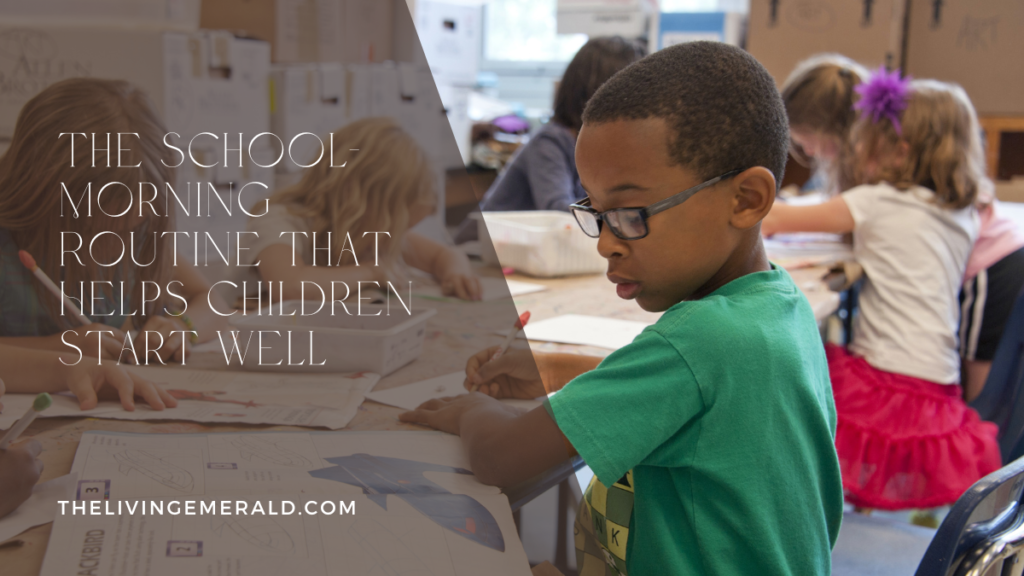
school-morning routine that helps children start well

The School-Morning Routine That Helps Children Start Well

The school-morning routine in our house is not dramatic. It is the same handful of moments, repeated on a loop: waking the children, helping them get dressed and ready, a short stretch at the table for breakfast, and then seeing them off before the day properly begins. Nothing about it looks remarkable from the outside. But a school-morning routine that helps children start well is one of the quietest, most repeated forms of parenting there is — and it teaches far more than it looks like it does. Why the School-Morning Routine Matters More Than It Seems Mornings are rushed by nature. There is a fixed departure time, several people who need to be ready by it, and very little room for negotiation. It would be easy to treat this stretch of the day as something to simply survive. But a school-morning routine that helps children start well is really doing two jobs at once: getting everyone out the door, and quietly teaching children that their day has structure, that they are expected to participate in it, and that someone reliable is present through it. Children absorb far more from the pattern of a morning than from any single instruction given during it. A routine repeated daily communicates something instructions alone cannot: this is how our family begins the day, and you have a place in it. What a Helpful Morning Routine Actually Looks Like It does not need to be elaborate. A workable school-morning routine that helps children start well usually includes the same few elements: a consistent wake time, a short window for getting dressed and ready without rushing, breakfast eaten together where possible, and a calm goodbye rather than a chaotic scramble out the door. The specific schedule matters far less than the fact that it repeats in a recognizable order every school day. What makes the difference is not perfection. Some mornings run late. Someone forgets a shoe. The goal is not a flawless routine — it is a dependable shape that children can recognize and lean on, even on the days it wobbles. Letting Children Gradually Own Parts of It One of the most useful shifts in a school-morning routine is handing children small, age-appropriate pieces of it to own themselves. A young child can learn to lay out their own clothes the night before. An older child can be responsible for packing their own bag or checking the weather to decide what to wear. This is not about reducing parental involvement — it is about using the routine as a training ground for responsibility, in stakes small enough that a mistake (a forgotten item, a wrinkled shirt) costs almost nothing to correct. Over time, a child who has practiced owning small pieces of the morning tends to carry that same instinct into bigger areas of responsibility later — schoolwork, chores, and eventually decisions well beyond the breakfast table. The Breakfast Table as More Than a Meal The few minutes at the table before school are often the most undervalued part of the entire routine. It is rarely a long or deep conversation — more often it is half-finished sentences, a question about the day ahead, an offhand comment about a dream from the night before. None of it is remarkable on its own. But early-childhood research on everyday family interactions consistently points to exactly this kind of small, repeated contact as one of the most reliable ways children come to feel known and secure — more reliable, in fact, than occasional big, planned moments. When the Routine Breaks Down Every family’s morning routine breaks occasionally — a late night before, an early meeting, a sick child. A school-morning routine that helps children start well doesn’t need to survive every disruption perfectly. What matters is that it resumes the next day without becoming a source of guilt or conflict. Children read a parent’s reaction to a broken routine as much as they read the routine itself; treating a chaotic morning as a normal, correctable event rather than a failure teaches resilience alongside structure. A Realistic Starting Point Building or improving a school-morning routine doesn’t require an overhaul. It can start with one small, fixed anchor — a consistent wake time, or five minutes at the table without phones — and grow from there. The rest of the routine tends to organize itself around one or two reliable anchors, rather than needing to be planned in full from day one. None of this needs to be dramatic to matter. Fatherhood and parenting are often built exactly this way — not through grand gestures, but through the same ordinary morning, shown up for, again and again. None of this needs to be dramatic to matter. A school-morning routine that helps children start well is really just a repeated, ordinary act of showing up. Related Reading See also Why You Should Answer the Same Question Again and Again and Your Kids Need Your Voice.

The School-Morning Routine That Helps Children Start Well Read More »

PARENTING
stop carrying other people's mistakes

The Hidden Cost of Being the Person Everyone Relies On

Stop carrying other people’s mistakes — it sounds simple until you’re the one everyone naturally turns to when something goes wrong. The missed deadline that becomes your problem to fix. The vendor who didn’t deliver, so you stay late redoing what should have already been done. The family member’s crisis that somehow always lands on your calendar. Why It’s So Easy to Start Carrying Other People’s Mistakes Being reliable is not the problem. The problem starts when reliability quietly turns into an unspoken agreement: you will always be the one who catches what falls. Running a small business alone for years taught me how naturally this happens — a client’s late payment becomes your cash-flow crisis, a supplier’s error becomes your apology to make, and eventually there’s no line left between what’s actually yours to carry and what simply landed on you because you were the dependable one. Nobody hands you this arrangement in writing. It builds itself, one rescued situation at a time. The first time you cover for someone, it feels like generosity. The tenth time, it feels like an obligation nobody ever actually agreed to, except you never said no, so it never got questioned. How the Pattern Becomes Invisible What makes this especially hard to see from the inside is that it usually comes wrapped in praise. “I don’t know what we’d do without you” sounds like appreciation, but it can also be a quiet signal that a system has been built entirely around one person absorbing everyone else’s shortfalls. The more competent and calm you are under pressure, the more invisible the pattern becomes — to everyone, including you. Over time, this shows up physically before it shows up as a conscious thought. A tightness that appears the moment the phone rings. A low-grade dread before checking messages on a Monday. These are often the first honest signals that the load has quietly become too heavy, long before the mind is willing to admit it. What It Costs to Stop Carrying Other People’s Mistakes — And What It Costs Not To The immediate cost of stepping back feels obvious: something might genuinely go wrong if you don’t catch it. But the long-term cost of never stepping back is bigger and quieter — burnout, resentment, and a life built around managing other people’s problems instead of building your own. People who are known as the ones who always fix things rarely get asked if they’re tired. They just keep getting handed more to fix. Research on workplace boundaries consistently shows that the people who protect their limits, rather than absorbing every problem around them, tend to sustain their output — and their health — far longer than those who don’t. Ironically, the people who never learn to say no are often the first to disappear from a team entirely — not through conflict, but through slow, quiet burnout that looks like withdrawal rather than collapse. Three Ways to Actually Stop Carrying Other People’s Mistakes Return the problem to its owner. Instead of quietly fixing someone else’s error, name it and ask what they plan to do about it before stepping in. Build a system instead of being the system. A checklist, a clear deadline, or a written process can catch what used to depend entirely on your memory and vigilance. Say the sentence out loud. “I can’t take this one on” is a complete sentence. It doesn’t require an apology or a full explanation. Learning to stop carrying other people’s mistakes doesn’t happen in one conversation. It happens one boundary at a time, in the small daily moments where the old habit says “just fix it” and a new one says “not this time.” The first few times will feel uncomfortable, even wrong — that discomfort is not proof you’re doing something harmful. It’s usually just proof you’re doing something unfamiliar. None of this means abandoning people who genuinely need help. It means being honest about the difference between helping and permanently absorbing someone else’s responsibility as your own. A business, a family, or a team that depends entirely on one person quietly catching every mistake isn’t actually stable — it just looks stable, right up until that person runs out of capacity to keep catching them. Related Reading See also The Accidental Solopreneur and When One Income Source Disappears.

The Hidden Cost of Being the Person Everyone Relies On Read More »

LIFE
Shopping Cart
Scroll to Top