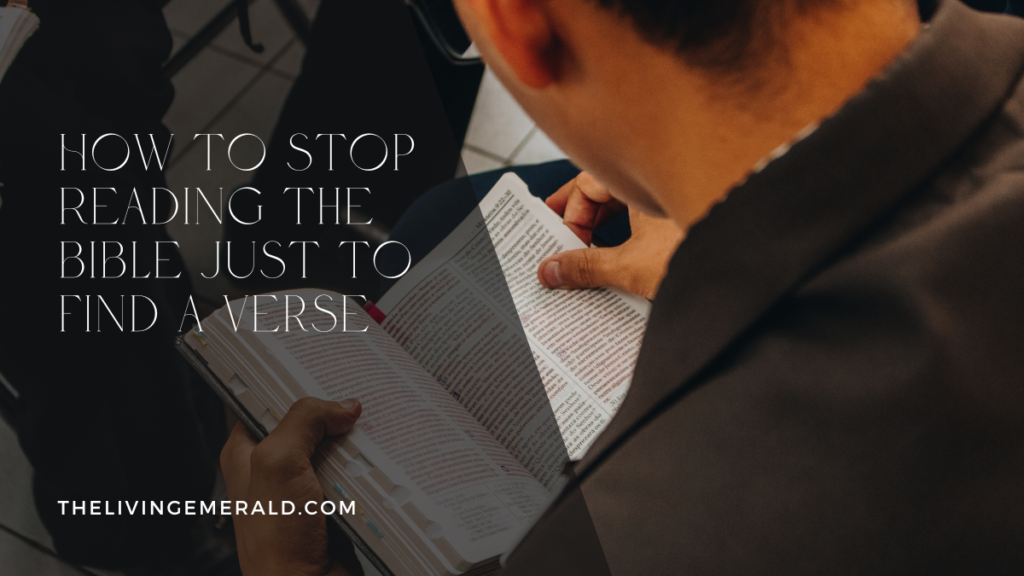
Reading the Bible for real life is different from reading it to find a verse. There is a way of reading the Bible that turns it into a search engine. Something goes wrong, or a decision needs making, and you scroll until a verse matches the mood — screenshot it, post it, move on. It works in the moment. It also quietly trains you to skip the actual point of Scripture: the story, the original audience, the tension the passage was written into.
Reading the Bible for real life means slowing down enough to ask what a passage meant before asking what it means for you today. That order matters more than it sounds like it should.
Why verse-hunting feels so useful
When life is uncertain, a single clear sentence feels like relief. “For I know the plans I have for you” is shorter and more manageable than reading all of Jeremiah’s warnings to a nation about to go into exile, understanding why he said it, and then asking what it means for a very different situation centuries later. The verse alone is portable. The context is work.
The problem is not that the verse is wrong. It is that a sentence lifted out of its story can be made to say almost anything, and it usually ends up saying whatever we already wanted to hear.
What gets lost when a verse loses its story
Every verse has a “who is speaking, to whom, and why” behind it. Paul writing to a specific church with a specific problem is not the same as a universal formula for every reader in every century. A psalm written in the middle of genuine despair is not automatically a promise that despair will always resolve the way that psalm resolved. Reading the Bible for real life means letting a passage keep its original shape instead of flattening it into a slogan.
This is not about doubting Scripture. It is about respecting it enough to read it as it was actually written — as letters, histories, poems, and prophecy addressed to real people, not as a jar of individually wrapped promises.
Reading the Bible for real life: text, inference, interpretation, application
A useful habit is naming, honestly, which of these four things you are doing at any moment:
- Text: what the passage actually says, in its own words.
- Inference: what can reasonably be drawn from the text and its surrounding context.
- Interpretation: how the church has historically understood what it means.
- Application: what it means for your specific life right now.
Most verse-hunting skips straight from text to application, without passing through the two steps in between. That shortcut is where a lot of confusion and disappointment starts — a promise gets claimed that the text never actually made, and when life doesn’t match it, the doubt that follows is aimed at God rather than at the shortcut itself. The Bible Gateway’s guide to Scripture engagement makes a similar point: reading in context consistently produces deeper understanding than isolated verse study alone.
A slower way to actually read
Reading the Bible for real life does not require a seminary degree. It requires a few honest habits:
- Read the whole chapter the verse comes from, not just the verse, before deciding what it means.
- Ask who wrote it, who it was originally written to, and what was happening to them at the time.
- Notice what comes right before and right after the sentence you were drawn to.
- Ask what the passage teaches about God’s character generally, before asking what it promises you specifically.
This takes longer than a search. It also produces something a search cannot: a relationship with the actual text, not just with a collection of favorite lines pulled from it.
What this looks like in practice
Pick one book of the Bible — a short one is fine — and read a full chapter before you go looking for “the verse” for today. Let the chapter’s own argument unfold. When something strikes you, write down what the passage says first, then what it might reasonably mean, before deciding what it means for your specific situation. Over time, this builds something verse-hunting never quite gets to: a working knowledge of Scripture’s own shape, so that when a hard season comes, you’re not searching a stranger’s book for comfort — you’re returning to a story you already know.
Reading the Bible for real life is slower. It is also the difference between borrowing a verse and actually knowing the book it came from.
Related Reading
See also When You Still Love God but Don’t Feel Like Praying and When You Pray and Nothing Seems to Change.