
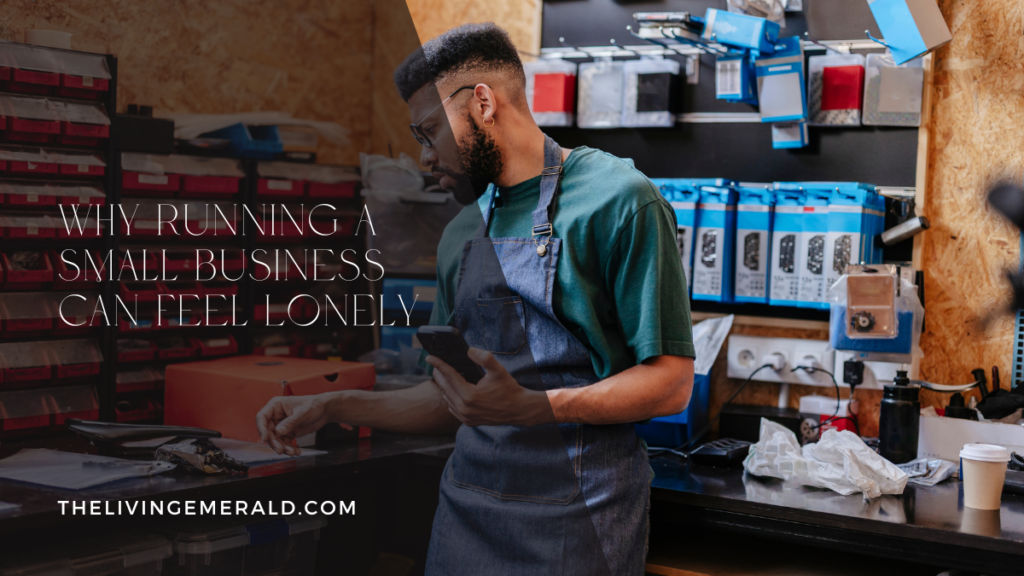
From the outside, a small business looks like freedom: your own hours, your own decisions, your own name on the door. From the inside, it often feels different. Cash flow worries follow you home. A late payment ruins a weekend. A difficult client stays in your head at midnight. The business owner’s emotional load is heavy, largely invisible and rarely talked about, and it explains why so many owners feel lonely even when they are surrounded by customers.
This perspective comes from years of running a small graphic-design and digital-printing business, with the client pressure, inconsistent income, vendors, tight timelines and the reality of working largely alone that come with it. The goal here is to normalise the experience and to suggest practical support. If you own a business, you are probably not the only one feeling this way.
What the Business Owner’s Emotional Load Actually Contains
Beyond the tasks, there is a constant weight of responsibility. You decide, and if you decide wrongly, you pay. You carry the fear that a slow month may turn into a slow year. You may be responsible for people whose income depends on yours. You wear every hat, from designer to accountant to complaints desk, and you do it with no one to hand the worry to at the end of the day.
Add the pressure to look confident. Clients want reassurance, staff want stability, and family wants to believe everything is fine. So owners often carry the anxiety privately, which is where the loneliness begins.
Why Running a Small Business Feels Lonely
Loneliness in business is not always about being alone in a room. It is about having no one who fully understands your position. Employees see the work but not the numbers. Family sees the stress but not the details. Friends in jobs may not grasp the strange mix of freedom and pressure. Many owners also avoid sharing struggles for fear of appearing weak or scaring customers.
Social media makes it worse. Other people’s launches, milestones and polished announcements make ordinary struggle feel like failure. What you see is the highlight, and what you do not see is everyone else’s late nights and unpaid invoices.
Five Signs the Load Is Getting Too Heavy
- You cannot switch off, and the business follows you into family time.
- Small setbacks feel far bigger than they are.
- You avoid talking about the business because it is easier to stay quiet.
- You are more irritable, tired or withdrawn than usual.
- You keep working because stopping feels dangerous, even when you are exhausted.
If several of these are true, take it as a message that you need support, not proof that you are failing.
Five Ways to Lighten the Load
- Talk to peers. A few trusted fellow owners, in person or online, can say “me too” in a way few others can.
- Find a mentor or trusted adviser. Someone a few steps ahead can offer perspective and stop you repeating avoidable mistakes.
- Separate your worth from your revenue. A bad month is a business problem, not a verdict on you as a person.
- Build simple systems. Regular routines for invoicing, follow-up and planning reduce the number of decisions you make while tired.
- Set boundaries around availability. Decide when you answer messages, and protect at least some time that is genuinely off.
Talk Honestly With the People at Home
Those closest to you can carry some of the weight if they know what it is. You do not need to share every detail or frighten anyone. A calm, honest update, such as “It has been a slow month and I am working on a plan,” lets your family understand the pressure and support you. It also stops the silence from turning into distance.
Listening matters both ways. Ask how your business affects them, and respect their limits. Businesses run better when the home is a place of rest and not a second workplace.
Build a Buffer, Practically and Emotionally
Financial buffers reduce anxiety. Even a modest reserve that covers a slow month changes how a downturn feels. Emotional buffers matter too: regular rest, exercise, time with people who are not connected to the business and, for believers, prayer and community. Our article on the cost of being available explores how always being reachable adds to the load, and what to do when life stops going to plan offers a way to handle setbacks.
Know When to Get Extra Help
Loneliness and stress are common, and persistent low mood, constant dread or thoughts of harming yourself are more serious. Please talk to a doctor, counsellor or trusted person. Organisations such as the Mental Health Foundation provide helpful general information about loneliness and how to respond to it. Asking for help is a practical decision, not a weakness.
Small Daily Habits That Ease the Weight
You do not need a dramatic change to reduce the business owner’s emotional load. Start the day by choosing the three tasks that matter most, and finish by writing down tomorrow’s first task so your mind can rest. Keep a short list of worries and next actions, so that a worry becomes a step and not a loop. Take short breaks during the day, and end work at a time you have chosen.
Celebrate small wins, too. Owners often move straight from one problem to the next without pausing when something goes well. A paid invoice, a happy client or a job delivered on time deserves a moment of acknowledgement. Recognising progress is a practical way to keep the business owner’s emotional load in proportion.
You Do Not Have to Carry It Alone
The business owner’s emotional load will not vanish, but it can be shared, structured and softened. Choose one step this week: call a fellow owner, set an evening boundary or tell someone at home what is really going on. Owning a business can be lonely, and it does not have to stay that way.
Remember that the business owner’s emotional load is shared by many people who never speak of it. Talking about the business owner’s emotional load, even briefly, is often the first step toward carrying it better.